Chitosan
How Chitosan Outperforms Synthetic Flocculants in Municipal Wastewater Treatment

Admin
Admin
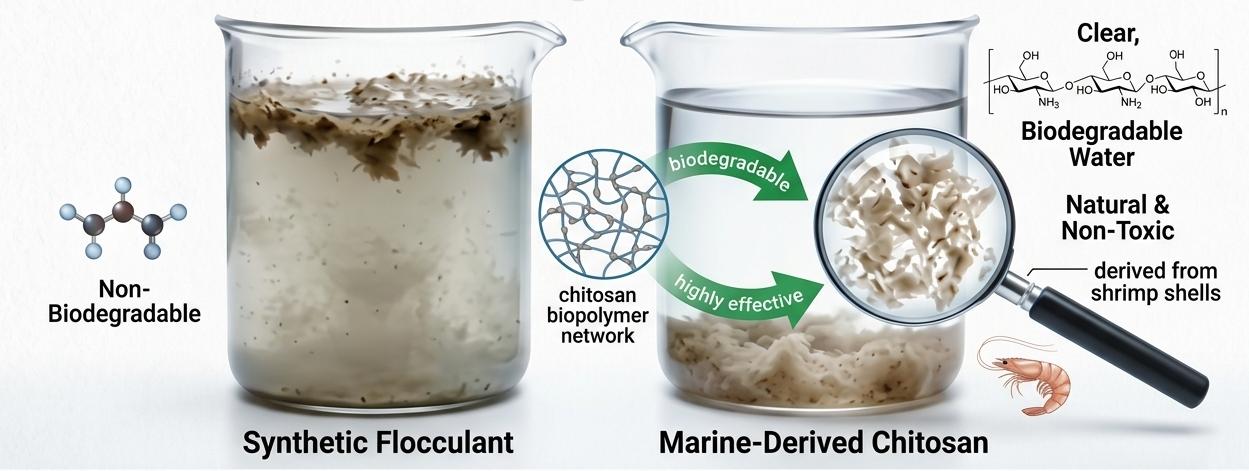
Wastewater treatment today faces a growing challenge: heavy reliance on synthetic chemicals. For decades, municipal and industrial treatment facilities have depended on conventional flocculants such as polyaluminium chloride (PAC), aluminium sulphate (alum), and polyacrylamide to meet discharge standards and clarify water. However, with increasing environmental and regulatory pressures, many operators are now actively searching for a reliable chitosan supplier for water treatment applications to transition towards more sustainable and compliant solutions.
Shrimp chitosan is one of the most technically credible natural flocculants available. It is not a fringe material or an emerging concept — it is a well-characterised biopolymer with decades of research behind it in water treatment contexts. What it has lacked until recently is a reliable supply chain that can meet the volume, quality consistency, and documentation requirements of the water treatment sector.
What Is Shrimp Chitosan and Why Does the Source Matter?
Chitosan is a deacetylated derivative of chitin — the structural polysaccharide found in crustacean exoskeletons. When shrimp shells are subjected to a demineralisation and deproteinisation process, chitin is extracted. Subsequent treatment with concentrated alkali (deacetylation) converts chitin into chitosan by removing acetyl groups from the polymer chain, exposing free amino groups (–NH2).
These amino groups are critical. In typical wastewater pH conditions (5–9), they become positively charged (–NH₃⁺), enabling chitosan to attract and bind negatively charged contaminants such as:
Suspended solids
Colloidal particles
Organic matter
Heavy metals
Microorganisms
Why Shrimp-Based Chitosan Is Preferred
Not all chitosan is equal. Shrimp-derived chitosan is widely preferred in water treatment due to:
High and consistent availability from aquaculture waste streams
Predictable chemical structure and processing behavior
More uniform degree of deacetylation (DD)
Better viscosity control compared to crab-derived alternatives
This consistency is crucial for large-scale wastewater treatment applications where reliability matters.
For a deeper look at chitin extraction and the structural differences between chitin and chitosan, our earlier blog Chitin and Chitosan: Biochemical Properties and Applications covers the chemistry in detail. And for the specific uses of shrimp shell chitin beyond water treatment, Shrimp Shell Chitin: Uses and Benefits in Modern Applications is worth reading alongside this piece.
The Problem With Synthetic Flocculants — An Honest Assessment
Before making the case for chitosan, it's worth being direct about why synthetic flocculants remain dominant despite their drawbacks. The case against them is not that they don't work — it's that the full cost of using them, including downstream costs and regulatory risk, is changing.
Aluminium-Based Coagulants (PAC, Alum)
These are cost-effective and widely available, but they introduce several concerns:
Residual aluminium in treated water
Increasing regulatory scrutiny (WHO and EU limits ~0.2 mg/L)
Potential links to long-term health risks
High sludge generation requiring costly disposal
Polyacrylamide (PAM)
While effective, PAM presents different challenges:
Risk of acrylamide monomer contamination (toxic and potentially carcinogenic)
Non-biodegradable polymer contributing to environmental persistence
Increasing restrictions related to microplastics and synthetic residues
As environmental regulations tighten globally, the long-term viability of these chemicals is under question.
How Chitosan Flocculation Works — The Mechanism
Understanding chitosan's mechanism of action helps process engineers predict its behaviour in specific wastewater matrices and optimise dosing and pH conditions for maximum effectiveness.
Chitosan achieves wastewater clarification through four complementary mechanisms that often work in combination:
• Charge neutralisation: The protonated amino groups of chitosan (–NH3+) directly neutralise the negative surface charges of suspended particles and colloids, destabilising the electrostatic repulsion that keeps particles dispersed. This is the primary mechanism and is most effective at mildly acidic to neutral pH (5.5–7.5).
• Bridging flocculation: Chitosan's long polymer chains can simultaneously bind to multiple particles, creating a physical bridge that aggregates them into larger flocs. This bridging action produces large, fast-settling flocs that are easy to separate by gravity settling, filtration, or dissolved air flotation (DAF).
• Sweep flocculation: At higher dosages, chitosan can precipitate and physically sweep suspended solids out of solution as it settles. This mechanism is less efficient than bridging but contributes to overall removal performance at high turbidity loads.
• Adsorption: Chitosan has high affinity for heavy metal ions, dissolved organic compounds, dyes, and certain micropollutants through both electrostatic attraction and coordination bonding with the amino and hydroxyl groups. This gives chitosan a secondary purification benefit beyond simple particle removal.
The net result is that chitosan typically achieves flocculation at lower dosages than synthetic polymers because of the combination of these mechanisms working simultaneously.
Performance Data: Chitosan vs PAC, Alum, and PAM
The following summary draws from published academic and industrial research on chitosan performance in wastewater treatment applications. These figures represent ranges from multiple studies — actual performance in a specific treatment plant will depend on wastewater composition, pH, temperature, and process configuration.
Parameter | Chitosan | PAC | Alum | PAM |
Turbidity removal | 85–98% | 75–95% | 70–92% | 80–95% |
COD reduction | 50–80% | 30–60% | 25–55% | Variable |
Heavy metal removal | High (adsorption) | Moderate | Moderate | Low |
Residual in treated water | Biodegradable, none | Al residuals | Al residuals | PAM/acrylamide risk |
Sludge volume generated | Lower | High | High | Moderate |
Biodegradable | Yes (OECD 301B) | No | No | No |
Effective pH range | 5.5–9.0 | 5.5–8.5 | 5.0–8.0 | Wide |
Halal/food-safe grade | Available | N/A | N/A | N/A |
Key Advantage: Heavy Metal Removal
Unlike aluminium-based coagulants, chitosan removes metals through true adsorption, forming chemical bonds with ions such as:
Lead (Pb²⁺)
Copper (Cu²⁺)
Cadmium (Cd²⁺)
Chromium (Cr⁶⁺)
Zinc (Zn²⁺)
This makes it especially valuable in industrial wastewater streams.
Application Areas: Which Wastewater Streams Benefit Most
Municipal Wastewater Treatment
Works effectively as a co-flocculant
Can reduce aluminium dosage by 30–60%
Lowers sludge production and residual metal content
Food & Beverage Industry
Excellent for removing organic loads, fats, oils, and grease (FOG)
Suitable for food-adjacent processing environments
Dairy Wastewater
Removes proteins and fat emulsions efficiently
Achieves high turbidity removal (>90%)
Produces biodegradable sludge with reuse potential
Aquaculture Systems
Removes particulates and pathogens safely
Non-toxic and environmentally compatible
Paper & Pulp Industry
Effective against lignin and cellulose-based contaminants
Improves clarification in high-COD effluents
For a broader picture of how chitosan serves industrial sectors including paper and agriculture, see our overview on the applications of shrimp chitosan from NMP's product page.
What Procurement Teams Need to Know: Evaluating a Chitosan Supplier
If you're evaluating shrimp chitosan as a potential flocculant for your operations, the procurement criteria are different from evaluating a standard chemical commodity. Here is what to ask for:
• Degree of deacetylation (DD): The DD value (typically expressed as a percentage) determines chitosan's cationic character and therefore its flocculation performance. For wastewater treatment applications, a DD of >85% is generally required for effective flocculation. Suppliers should provide DD data as part of their COA.
• Viscosity grade: Chitosan comes in low, medium, and high viscosity grades. For flocculation in water treatment, low-to-medium viscosity grades are typically preferred as they disperse more readily in aqueous solution. High viscosity chitosan is more suited to film-forming and gel applications.
• Ash content and moisture: High ash content indicates incomplete demineralisation during processing, which reduces the effective active content per unit weight. Moisture content affects shelf life and handling — look for <10% moisture.
• Heavy metals in the chitosan itself: Because shrimp shells can accumulate heavy metals from their environment, the chitosan product should have a documented heavy metals panel confirming compliance with the applicable standard for your application.
• Microbiological parameters: For wastewater treatment applications involving food processing effluent or drinking water contexts, microbiological cleanliness of the chitosan itself should be documented.
At Nizona Marine Products, we produce shrimp chitosan with documented degree of deacetylation >85%, available in low, medium, and high viscosity grades. Our COA documentation covers all the parameters above, and we can provide regulatory support documents for EU, UK, Singapore, and US market compliance requirements.
Why Chitosan Aligns with Future Regulations
Global policies are shifting toward greener water treatment solutions, including:
Reduced chemical residues
Lower sludge generation
Elimination of persistent synthetic polymers
Chitosan aligns well with these trends because it is:
Biodegradable (OECD 301B compliant)
Derived from renewable marine waste
Non-toxic and environmentally safe
Compatible with circular economy principles
This environmental profile connects chitosan to the broader marine biomaterials sustainability story. At NMP, our chitosan is produced from shrimp shells that would otherwise be discarded from aquaculture processing — a genuine circular economy application. For context on how this fits into the larger picture of marine biomaterial upcycling, our blog on Green Flocculants for Sustainable Wastewater Treatment covers the policy landscape in more detail.
Practical Implementation: Getting Started with Chitosan Flocculation
If you're considering a pilot trial of chitosan flocculation at your facility, here is a practical starting framework for your process engineering team:
• Jar test protocol first: Before any full-scale trial, conduct standard jar tests at your facility using your actual wastewater stream. Vary chitosan dose (typically 1–30 mg/L depending on suspended solids load), pH (adjust to 6–7 for optimal performance), and mixing parameters. Measure turbidity, COD, and settleability of flocs.
• pH management: Chitosan performs best at pH 5.5–7.5. If your wastewater is highly alkaline (pH >9), you may need to acidify slightly before chitosan addition. This is a minor operational adjustment but important to note.
• Combination dosing: In many applications, a hybrid approach using reduced PAC or alum doses plus chitosan as a flocculant aid delivers the best performance-per-cost. This approach also reduces aluminium residuals while achieving comparable or superior clarification.
• Dosage optimisation: Over-dosing chitosan can re-stabilise colloids (charge reversal). Start conservative (2–5 mg/L) and increase to find the optimum dose. Your supplier should be able to provide guidance based on your specific wastewater profile.
Our team at Nizona Marine Products is available to support process engineers and procurement teams evaluating chitosan for water treatment. Contact us to request samples, COA documentation, and application support.
Frequently Asked Questions: Chitosan in Wastewater Treatment
Is chitosan approved for use in drinking water treatment?
Yes, chitosan is approved for use in drinking water treatment in several jurisdictions, including in the US (NSF/ANSI Standard 60 certified products are available) and in EU member states under national authorisation schemes. For industrial wastewater applications, approval is generally not required as the treated water is not entering the drinking water supply. However, you should verify the specific regulatory status for your application and geography with your local environmental regulator.
How does chitosan compare to polyaluminium chloride (PAC) on cost?
Chitosan commands a higher unit cost than PAC on a per-kilogram basis. However, the relevant cost comparison is per unit volume of water treated to a given quality standard. Because chitosan is typically effective at lower dosage rates and reduces or eliminates aluminium sludge disposal costs, the total treatment cost per cubic metre of effluent is often comparable or favourable when these factors are considered. A detailed cost-benefit analysis requires a site-specific evaluation based on your wastewater load, current dosage rates, and sludge disposal costs.
What viscosity grade of chitosan is best for wastewater treatment?
Low to medium viscosity chitosan grades are generally preferred for wastewater treatment applications because they dissolve more readily and disperse more efficiently in large-volume treatment systems. High viscosity chitosan is more suitable for film-forming, encapsulation, and gel applications. Your chitosan supplier should be able to recommend the appropriate grade based on your specific application and process configuration.
Can chitosan remove heavy metals from industrial wastewater?
Yes — chitosan is one of the most effective natural materials for heavy metal removal from wastewater. The amino groups on the chitosan chain form coordination bonds with metal cations including lead, copper, cadmium, chromium (VI), zinc, and mercury. Removal efficiencies of 80–99% have been reported for several of these metals under optimised conditions. The specific performance will depend on chitosan degree of deacetylation, dose, pH, metal concentration, and the presence of competing ions in solution.
Is shrimp-derived chitosan suitable for food processing wastewater applications?
Yes. Shrimp chitosan is naturally food-safe and non-toxic. For use in wastewater treatment systems associated with food processing operations, we recommend confirming the chitosan grade meets any relevant food-contact-adjacent regulatory requirements for your specific facility. This typically means requesting a COA with heavy metals, microbiological parameters, and residual solvent documentation from your supplier.
Wastewater treatment today faces a growing challenge: heavy reliance on synthetic chemicals. For decades, municipal and industrial treatment facilities have depended on conventional flocculants such as polyaluminium chloride (PAC), aluminium sulphate (alum), and polyacrylamide to meet discharge standards and clarify water. However, with increasing environmental and regulatory pressures, many operators are now actively searching for a reliable chitosan supplier for water treatment applications to transition towards more sustainable and compliant solutions.
Shrimp chitosan is one of the most technically credible natural flocculants available. It is not a fringe material or an emerging concept — it is a well-characterised biopolymer with decades of research behind it in water treatment contexts. What it has lacked until recently is a reliable supply chain that can meet the volume, quality consistency, and documentation requirements of the water treatment sector.
What Is Shrimp Chitosan and Why Does the Source Matter?
Chitosan is a deacetylated derivative of chitin — the structural polysaccharide found in crustacean exoskeletons. When shrimp shells are subjected to a demineralisation and deproteinisation process, chitin is extracted. Subsequent treatment with concentrated alkali (deacetylation) converts chitin into chitosan by removing acetyl groups from the polymer chain, exposing free amino groups (–NH2).
These amino groups are critical. In typical wastewater pH conditions (5–9), they become positively charged (–NH₃⁺), enabling chitosan to attract and bind negatively charged contaminants such as:
Suspended solids
Colloidal particles
Organic matter
Heavy metals
Microorganisms
Why Shrimp-Based Chitosan Is Preferred
Not all chitosan is equal. Shrimp-derived chitosan is widely preferred in water treatment due to:
High and consistent availability from aquaculture waste streams
Predictable chemical structure and processing behavior
More uniform degree of deacetylation (DD)
Better viscosity control compared to crab-derived alternatives
This consistency is crucial for large-scale wastewater treatment applications where reliability matters.
For a deeper look at chitin extraction and the structural differences between chitin and chitosan, our earlier blog Chitin and Chitosan: Biochemical Properties and Applications covers the chemistry in detail. And for the specific uses of shrimp shell chitin beyond water treatment, Shrimp Shell Chitin: Uses and Benefits in Modern Applications is worth reading alongside this piece.
The Problem With Synthetic Flocculants — An Honest Assessment
Before making the case for chitosan, it's worth being direct about why synthetic flocculants remain dominant despite their drawbacks. The case against them is not that they don't work — it's that the full cost of using them, including downstream costs and regulatory risk, is changing.
Aluminium-Based Coagulants (PAC, Alum)
These are cost-effective and widely available, but they introduce several concerns:
Residual aluminium in treated water
Increasing regulatory scrutiny (WHO and EU limits ~0.2 mg/L)
Potential links to long-term health risks
High sludge generation requiring costly disposal
Polyacrylamide (PAM)
While effective, PAM presents different challenges:
Risk of acrylamide monomer contamination (toxic and potentially carcinogenic)
Non-biodegradable polymer contributing to environmental persistence
Increasing restrictions related to microplastics and synthetic residues
As environmental regulations tighten globally, the long-term viability of these chemicals is under question.
How Chitosan Flocculation Works — The Mechanism
Understanding chitosan's mechanism of action helps process engineers predict its behaviour in specific wastewater matrices and optimise dosing and pH conditions for maximum effectiveness.
Chitosan achieves wastewater clarification through four complementary mechanisms that often work in combination:
• Charge neutralisation: The protonated amino groups of chitosan (–NH3+) directly neutralise the negative surface charges of suspended particles and colloids, destabilising the electrostatic repulsion that keeps particles dispersed. This is the primary mechanism and is most effective at mildly acidic to neutral pH (5.5–7.5).
• Bridging flocculation: Chitosan's long polymer chains can simultaneously bind to multiple particles, creating a physical bridge that aggregates them into larger flocs. This bridging action produces large, fast-settling flocs that are easy to separate by gravity settling, filtration, or dissolved air flotation (DAF).
• Sweep flocculation: At higher dosages, chitosan can precipitate and physically sweep suspended solids out of solution as it settles. This mechanism is less efficient than bridging but contributes to overall removal performance at high turbidity loads.
• Adsorption: Chitosan has high affinity for heavy metal ions, dissolved organic compounds, dyes, and certain micropollutants through both electrostatic attraction and coordination bonding with the amino and hydroxyl groups. This gives chitosan a secondary purification benefit beyond simple particle removal.
The net result is that chitosan typically achieves flocculation at lower dosages than synthetic polymers because of the combination of these mechanisms working simultaneously.
Performance Data: Chitosan vs PAC, Alum, and PAM
The following summary draws from published academic and industrial research on chitosan performance in wastewater treatment applications. These figures represent ranges from multiple studies — actual performance in a specific treatment plant will depend on wastewater composition, pH, temperature, and process configuration.
Parameter | Chitosan | PAC | Alum | PAM |
Turbidity removal | 85–98% | 75–95% | 70–92% | 80–95% |
COD reduction | 50–80% | 30–60% | 25–55% | Variable |
Heavy metal removal | High (adsorption) | Moderate | Moderate | Low |
Residual in treated water | Biodegradable, none | Al residuals | Al residuals | PAM/acrylamide risk |
Sludge volume generated | Lower | High | High | Moderate |
Biodegradable | Yes (OECD 301B) | No | No | No |
Effective pH range | 5.5–9.0 | 5.5–8.5 | 5.0–8.0 | Wide |
Halal/food-safe grade | Available | N/A | N/A | N/A |
Key Advantage: Heavy Metal Removal
Unlike aluminium-based coagulants, chitosan removes metals through true adsorption, forming chemical bonds with ions such as:
Lead (Pb²⁺)
Copper (Cu²⁺)
Cadmium (Cd²⁺)
Chromium (Cr⁶⁺)
Zinc (Zn²⁺)
This makes it especially valuable in industrial wastewater streams.
Application Areas: Which Wastewater Streams Benefit Most
Municipal Wastewater Treatment
Works effectively as a co-flocculant
Can reduce aluminium dosage by 30–60%
Lowers sludge production and residual metal content
Food & Beverage Industry
Excellent for removing organic loads, fats, oils, and grease (FOG)
Suitable for food-adjacent processing environments
Dairy Wastewater
Removes proteins and fat emulsions efficiently
Achieves high turbidity removal (>90%)
Produces biodegradable sludge with reuse potential
Aquaculture Systems
Removes particulates and pathogens safely
Non-toxic and environmentally compatible
Paper & Pulp Industry
Effective against lignin and cellulose-based contaminants
Improves clarification in high-COD effluents
For a broader picture of how chitosan serves industrial sectors including paper and agriculture, see our overview on the applications of shrimp chitosan from NMP's product page.
What Procurement Teams Need to Know: Evaluating a Chitosan Supplier
If you're evaluating shrimp chitosan as a potential flocculant for your operations, the procurement criteria are different from evaluating a standard chemical commodity. Here is what to ask for:
• Degree of deacetylation (DD): The DD value (typically expressed as a percentage) determines chitosan's cationic character and therefore its flocculation performance. For wastewater treatment applications, a DD of >85% is generally required for effective flocculation. Suppliers should provide DD data as part of their COA.
• Viscosity grade: Chitosan comes in low, medium, and high viscosity grades. For flocculation in water treatment, low-to-medium viscosity grades are typically preferred as they disperse more readily in aqueous solution. High viscosity chitosan is more suited to film-forming and gel applications.
• Ash content and moisture: High ash content indicates incomplete demineralisation during processing, which reduces the effective active content per unit weight. Moisture content affects shelf life and handling — look for <10% moisture.
• Heavy metals in the chitosan itself: Because shrimp shells can accumulate heavy metals from their environment, the chitosan product should have a documented heavy metals panel confirming compliance with the applicable standard for your application.
• Microbiological parameters: For wastewater treatment applications involving food processing effluent or drinking water contexts, microbiological cleanliness of the chitosan itself should be documented.
At Nizona Marine Products, we produce shrimp chitosan with documented degree of deacetylation >85%, available in low, medium, and high viscosity grades. Our COA documentation covers all the parameters above, and we can provide regulatory support documents for EU, UK, Singapore, and US market compliance requirements.
Why Chitosan Aligns with Future Regulations
Global policies are shifting toward greener water treatment solutions, including:
Reduced chemical residues
Lower sludge generation
Elimination of persistent synthetic polymers
Chitosan aligns well with these trends because it is:
Biodegradable (OECD 301B compliant)
Derived from renewable marine waste
Non-toxic and environmentally safe
Compatible with circular economy principles
This environmental profile connects chitosan to the broader marine biomaterials sustainability story. At NMP, our chitosan is produced from shrimp shells that would otherwise be discarded from aquaculture processing — a genuine circular economy application. For context on how this fits into the larger picture of marine biomaterial upcycling, our blog on Green Flocculants for Sustainable Wastewater Treatment covers the policy landscape in more detail.
Practical Implementation: Getting Started with Chitosan Flocculation
If you're considering a pilot trial of chitosan flocculation at your facility, here is a practical starting framework for your process engineering team:
• Jar test protocol first: Before any full-scale trial, conduct standard jar tests at your facility using your actual wastewater stream. Vary chitosan dose (typically 1–30 mg/L depending on suspended solids load), pH (adjust to 6–7 for optimal performance), and mixing parameters. Measure turbidity, COD, and settleability of flocs.
• pH management: Chitosan performs best at pH 5.5–7.5. If your wastewater is highly alkaline (pH >9), you may need to acidify slightly before chitosan addition. This is a minor operational adjustment but important to note.
• Combination dosing: In many applications, a hybrid approach using reduced PAC or alum doses plus chitosan as a flocculant aid delivers the best performance-per-cost. This approach also reduces aluminium residuals while achieving comparable or superior clarification.
• Dosage optimisation: Over-dosing chitosan can re-stabilise colloids (charge reversal). Start conservative (2–5 mg/L) and increase to find the optimum dose. Your supplier should be able to provide guidance based on your specific wastewater profile.
Our team at Nizona Marine Products is available to support process engineers and procurement teams evaluating chitosan for water treatment. Contact us to request samples, COA documentation, and application support.
Frequently Asked Questions: Chitosan in Wastewater Treatment
Is chitosan approved for use in drinking water treatment?
Yes, chitosan is approved for use in drinking water treatment in several jurisdictions, including in the US (NSF/ANSI Standard 60 certified products are available) and in EU member states under national authorisation schemes. For industrial wastewater applications, approval is generally not required as the treated water is not entering the drinking water supply. However, you should verify the specific regulatory status for your application and geography with your local environmental regulator.
How does chitosan compare to polyaluminium chloride (PAC) on cost?
Chitosan commands a higher unit cost than PAC on a per-kilogram basis. However, the relevant cost comparison is per unit volume of water treated to a given quality standard. Because chitosan is typically effective at lower dosage rates and reduces or eliminates aluminium sludge disposal costs, the total treatment cost per cubic metre of effluent is often comparable or favourable when these factors are considered. A detailed cost-benefit analysis requires a site-specific evaluation based on your wastewater load, current dosage rates, and sludge disposal costs.
What viscosity grade of chitosan is best for wastewater treatment?
Low to medium viscosity chitosan grades are generally preferred for wastewater treatment applications because they dissolve more readily and disperse more efficiently in large-volume treatment systems. High viscosity chitosan is more suitable for film-forming, encapsulation, and gel applications. Your chitosan supplier should be able to recommend the appropriate grade based on your specific application and process configuration.
Can chitosan remove heavy metals from industrial wastewater?
Yes — chitosan is one of the most effective natural materials for heavy metal removal from wastewater. The amino groups on the chitosan chain form coordination bonds with metal cations including lead, copper, cadmium, chromium (VI), zinc, and mercury. Removal efficiencies of 80–99% have been reported for several of these metals under optimised conditions. The specific performance will depend on chitosan degree of deacetylation, dose, pH, metal concentration, and the presence of competing ions in solution.
Is shrimp-derived chitosan suitable for food processing wastewater applications?
Yes. Shrimp chitosan is naturally food-safe and non-toxic. For use in wastewater treatment systems associated with food processing operations, we recommend confirming the chitosan grade meets any relevant food-contact-adjacent regulatory requirements for your specific facility. This typically means requesting a COA with heavy metals, microbiological parameters, and residual solvent documentation from your supplier.
Related Blogs






Whatever we produce,
We must fully use
Contact Us



Phone No:
022 4924 0706
+91 9730007882

Email Address:

Location:
923, IJMIMA complex, MDP Road, Malad West, Mumbai – 400064, Maharashtra, India.
71/17, Topsia Road(South), Near Millat Nagar Masjid, Kolkata: 700046, West Bengal, India.
© 2026 Nizona Marine Products Private Limited. All Rights Reserved.
Whatever we produce,
We must fully use
Contact Us
Phone No:
022 4924 0706
+91 9730007882
Email Address:
Location:
923, IJMIMA complex, MDP Road, Malad West, Mumbai – 400064, Maharashtra, India.
71/17, Topsia Road(South), Near Millat Nagar Masjid, Kolkata: 700046, West Bengal, India.
© 2026 Nizona Marine Products Private Limited. All Rights Reserved.
Whatever we produce,
We must fully use
Contact Us
Phone No:
022 4924 0706
+91 9730007882
Email Address:
Location:
923, IJMIMA complex, MDP Road, Malad West, Mumbai – 400064, Maharashtra, India.
71/17, Topsia Road(South), Near Millat Nagar Masjid, Kolkata: 700046, West Bengal, India.
© 2026 Nizona Marine Products Private Limited. All Rights Reserved.